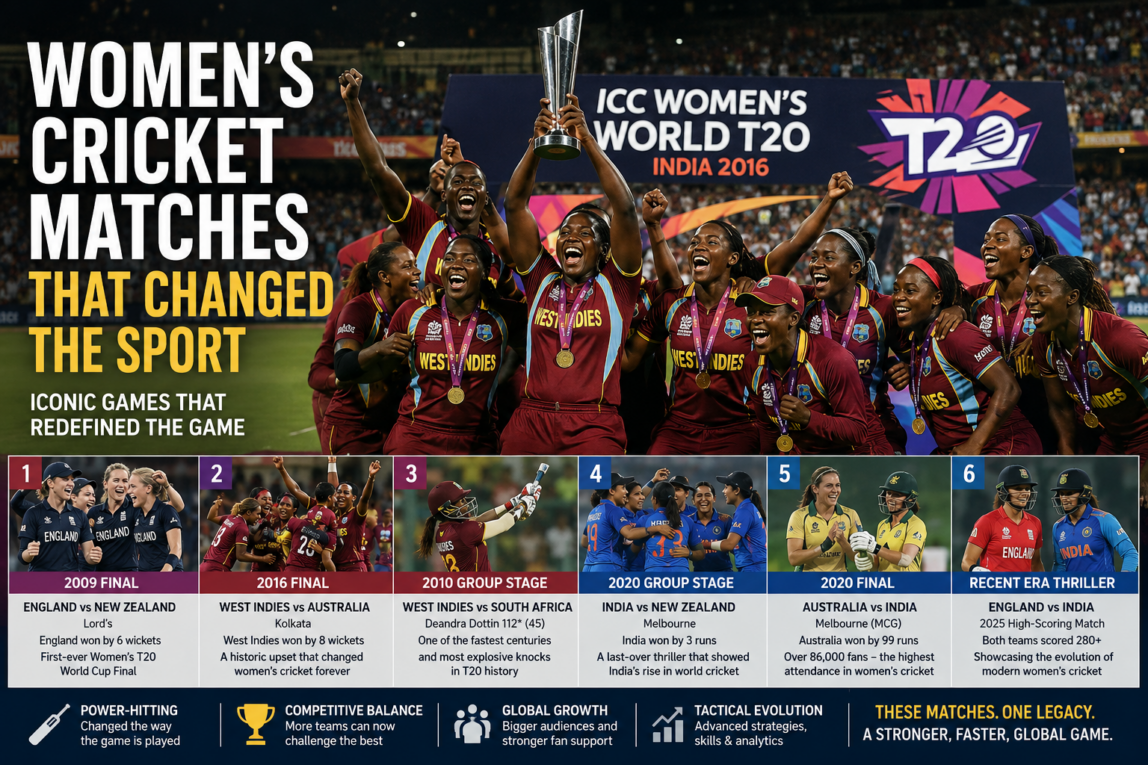
Women’s Cricket Matches That Changed the Sport
Women’s cricket has transformed dramatically over the past two decades. What was once seen as a developing branch of the sport is now a global spectacle filled with record-breaking performances, packed stadiums, and unforgettable finishes. Several key matches have not only entertained fans but also changed how women’s cricket is perceived worldwide.
From World Cup finals to historic group-stage thrillers, these matches have shaped the identity, popularity, and future of women’s cricket.
The Rise of Women’s Cricket Through Defining Matches
The ICC Women’s T20 World Cup, launched in 2009, became a turning point for the women’s game. It gave players a global stage and introduced audiences to high-intensity cricket filled with skill and drama. Over time, matches in this tournament have become more competitive, with teams like Australia, England, India, and West Indies pushing standards higher each year.
According to ICC archives, these matches highlight how women’s cricket has evolved from low-scoring tactical games to aggressive, high-impact contests featuring power-hitting and world-class bowling attacks .
1. England vs New Zealand – 2009 World Cup Final (Lord’s)
The 2009 final at Lord’s was a historic moment—it was the first-ever ICC Women’s T20 World Cup final. England’s disciplined bowling attack, led by Katherine Brunt, dismantled New Zealand for just 85 runs.
England then chased the target with composure, winning by 6 wickets and becoming the first-ever Women’s T20 World Cup champions.
This match mattered not just for the result, but for what it represented: the beginning of a new global platform for women’s cricket.
2. West Indies vs Australia – 2016 World Cup Final (Kolkata)
If one match truly changed perceptions, it was the 2016 final.
Australia entered as favourites, but West Indies stunned the cricketing world. Chasing 149, Stafanie Taylor and 18-year-old Hayley Matthews built a match-winning partnership that broke Australia’s dominance.
West Indies won by 8 wickets, marking their first-ever ICC world title.
This victory proved that women’s cricket was no longer dominated by a single nation and that underdog teams could win on the biggest stage. It also inspired aggressive batting approaches across the world.
3. West Indies vs South Africa – 2010 Group Stage (Record-Breaking Knock)
One of the most explosive innings in cricket history came from Deandra Dottin, who scored 112* off just 45 balls.
Her fearless hitting introduced a new brand of power cricket in the women’s game. At the time, centuries in T20 cricket were rare, especially in women’s matches.
This innings became a blueprint for modern attacking cricket and encouraged players to adopt a more fearless mindset.
4. India vs New Zealand – 2020 Group Stage Thriller (Melbourne)
This match was a turning point for India’s rise in world cricket. India posted a competitive total, and the match went down to the final over.
A dramatic run-out on the last ball sealed a 3-run victory for India.
What made this match important was not just the result, but the intensity. It showed that women’s group-stage matches could deliver knockout-level pressure, helping elevate viewership and global attention.
5. Australia vs India – 2020 Final (MCG, Record Attendance)
The 2020 final at the Melbourne Cricket Ground was a landmark moment in women’s cricket history. Over 86,000 fans attended the match, the highest-ever crowd for a women’s cricket game.
Australia dominated with Alyssa Healy’s explosive 75 and Beth Mooney’s unbeaten 78, posting 184/4. India struggled under pressure and lost by 99 runs.
Despite the one-sided result, the match was a breakthrough for visibility, showing that women’s cricket could attract massive stadium audiences and global broadcast attention .
6. England vs India – Recent High-Scoring Thriller (Modern Era Evolution)
In more recent years, matches like England vs India have shown how competitive the women’s game has become. A 2025 encounter saw England narrowly defeat India in a high-scoring contest, where both teams crossed 280+ runs.
Such matches reflect a major shift in the sport—higher strike rates, deeper batting lineups, and improved bowling strategies.
These modern contests prove that women’s cricket now mirrors the intensity and structure of elite men’s cricket.
How These Matches Changed Women’s Cricket
Across all these iconic games, a few key transformations stand out:
1. Rise of Power-Hitting
Players like Deandra Dottin and Hayley Matthews changed how batting is approached, bringing aggression into T20 cricket.
2. Competitive Balance
West Indies’ 2016 win and India’s rise show that more teams can now challenge traditional powerhouses like Australia and England.
3. Global Audience Growth
The 2020 MCG final proved women’s cricket can fill stadiums and attract global broadcast audiences.
4. Tactical Evolution
Modern matches feature advanced strategies, analytics, and specialized roles similar to men’s cricket.
Why These Matches Matter Today
Women’s cricket is no longer just developing—it is thriving. These historic matches helped shape its identity and pushed governing bodies to invest more in leagues, grassroots programs, and international tournaments.
As highlighted by ICC reports, the Women’s T20 World Cup has consistently produced moments that redefine the direction of the sport and inspire future generations .
Final Thoughts
The evolution of women’s cricket is deeply tied to iconic matches that changed perceptions forever. From England’s historic 2009 triumph to West Indies’ breakthrough in 2016 and Australia’s dominance in modern finals, each game has contributed to the sport’s rapid rise.
Today, women’s cricket is faster, more competitive, and more popular than ever before. And if history is any indication, the next generation of matches will continue to push boundaries and create even bigger moments.
FAQs
1. Which match changed women’s cricket the most?
The 2016 ICC Women’s T20 World Cup final (West Indies vs Australia) is often considered the most transformative due to the upset victory.
2. What is the highest-attended women’s cricket match?
The 2020 Women’s T20 World Cup final at the MCG, with over 86,000 spectators.
3. Who is known for the fastest century in women’s T20 World Cup history?
Deandra Dottin, with her 112* off 45 balls in 2010.
4. Why is the 2009 final important?
It was the inaugural Women’s T20 World Cup final and marked the official global rise of the format.
5. How has women’s cricket evolved recently?
It has become more aggressive, competitive, and commercially popular, with higher scoring rates and larger audiences.