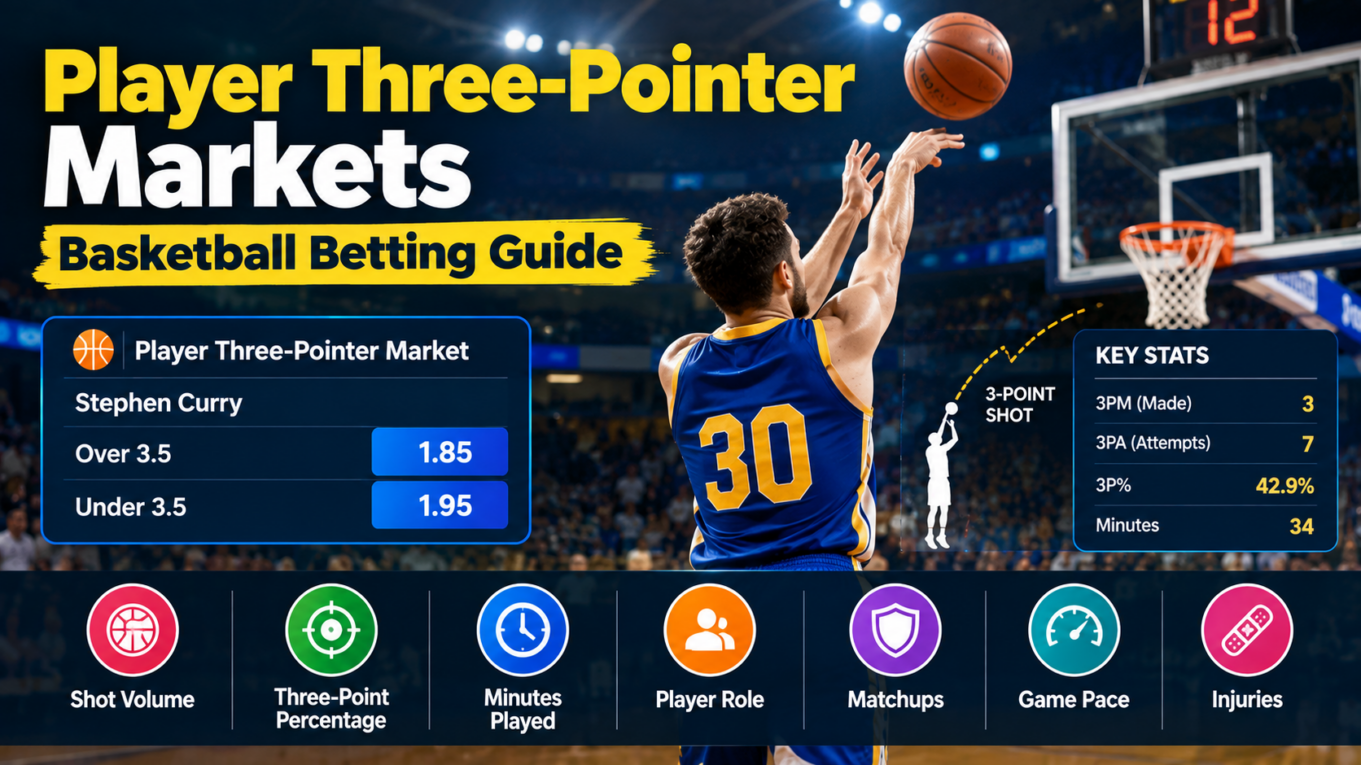
Basketball betting has developed well beyond simply choosing which team will win. Modern sportsbooks offer a wide range of player-focused markets, allowing bettors to follow individual performances throughout a game. Among these options, player three-pointer markets have become an important part of basketball betting.
These markets focus on how many three-point field goals a specific player will make during a game. Because three-point shooting can change quickly with shot volume, playing time, defensive pressure and game situation, understanding the market requires more than looking at a player’s scoring average.
For anyone following basketball betting, knowing how three-pointer markets are structured can make these options easier to understand.
What Are Player Three-Pointer Markets?
A player three-pointer market is based on the number of successful three-point field goals made by a particular player.
For example, a sportsbook may list a line of 2.5 three-pointers for a player. The available selections could be:
- Over 2.5 three-pointers
- Under 2.5 three-pointers
If the player makes three three-point shots, the result is above the listed line. If the player makes two or fewer, it falls below the line.
The market measures made three-pointers, not simply attempts. This distinction is important because a player can attempt several shots from outside the arc without necessarily making them.
The NBA’s official statistics glossary separately records three-point attempts (3PA), three-pointers made (3PM), and three-point percentage (3P%), making these useful statistics when understanding a player’s shooting profile.
How Three-Pointers Are Scored
In NBA basketball, a successful field goal from outside the three-point field-goal line counts for three points. The official rules also specify that the shooter must not be touching the three-point line when releasing the attempt.
This makes the location of the shot relevant when analysing player three-pointer markets.
Corner threes, above-the-break attempts and shots created through pick-and-roll situations can all contribute to a player’s three-point total. However, the number of attempts a player receives can vary significantly from one game to another.
Made Threes vs Three-Point Attempts
One of the most common mistakes when looking at player three-pointer markets is confusing attempts with successful shots.
Consider two players:
Player A
- 8 three-point attempts
- 2 made three-pointers
Player B
- 4 three-point attempts
- 3 made three-pointers
Player A had greater shot volume, but Player B produced more made threes.
The NBA defines 3PA as the number of three-point field goals attempted and 3PM as the number made. Three-point percentage is calculated from made attempts divided by total attempts.
Looking at all three figures provides a more complete picture than relying on one number.
Why Playing Time Matters
Minutes played can have a direct effect on three-point opportunities.
A starter who regularly plays 32–38 minutes may have more chances to shoot than a bench player who receives 15–20 minutes. However, playing time is not guaranteed. Foul trouble, injuries, rotations, blowouts and coaching decisions can all change a player’s minutes.
This is particularly relevant for live basketball markets. A player who has already played substantial minutes early in the game may have a different opportunity profile later compared with someone who has spent more time on the bench.
Shot Volume Is an Important Factor
A player’s three-point percentage tells you how efficiently they have converted their attempts, but shot volume provides another important piece of information.
A player averaging six or seven three-point attempts per game has more opportunities to reach a higher made-three total than a player who normally attempts two or three.
However, volume alone does not guarantee a particular outcome. Defensive schemes, shooting form, pace and game circumstances can influence how many attempts are available and how efficiently they are converted.
Role and Offensive System
A player’s role within the team’s offensive system can influence three-point opportunities.
Some players are primary ball-handlers who create their own shots. Others operate mainly as catch-and-shoot options around the perimeter. Some big men may also be used as floor spacers, while certain guards are encouraged to shoot frequently in transition.
This is why two players with similar scoring averages can have very different three-point profiles.
A player’s recent role can also change after an injury to a teammate or a change in the starting lineup. More offensive responsibility may lead to additional shot attempts.
Matchup and Defensive Pressure
The opposing team’s defensive approach can also affect three-point opportunities.
A team that aggressively closes out on perimeter shooters may force players away from open attempts. Another defensive scheme may allow more outside shots while attempting to protect the paint.
The quality and style of the opposing defense therefore provide useful context when examining a three-pointer market.
It is also worth distinguishing between open and contested attempts. The NBA’s statistical glossary tracks contested three-point attempts and contested three-point shooting, providing additional information about the conditions surrounding a player’s shots.
Pace Can Change the Number of Opportunities
Game pace is another factor worth considering.
A faster-paced matchup can produce more possessions, which may create additional opportunities for three-point attempts. A slower game can reduce the number of possessions available to both teams.
However, pace should not be considered in isolation. A team may play quickly but generate relatively few perimeter attempts, while another team can play at a moderate pace and rely heavily on three-point shooting.
The team’s offensive style and the player’s role should therefore be considered alongside pace.
Understanding Live Three-Pointer Markets
Live markets can change throughout a basketball game as player statistics develop.
Suppose a player has a three-pointer line of 3.5 before tip-off. If that player makes three threes during the first half, the live market may reflect the remaining game time, current shooting performance and expected opportunities.
At the same time, factors such as foul trouble, minutes restrictions or an unexpected change in the game score can affect future playing time.
NBA statistics are updated in real time for basic player and team statistics, which makes live statistical tracking particularly useful when following player markets.
Player Three-Pointers and Basketball Betting
Player three-pointer markets can sit alongside other basketball options such as player points, rebounds, assists and combined player statistics.
For readers following Cricbet99 basketball betting, understanding these individual markets can provide useful context when moving beyond traditional match-result options.
The key is to identify exactly what the market measures. A player points market and a player three-pointer market are not interchangeable. A player could score 25 points while making only one three-pointer, depending on how those points are produced.
What Should You Check Before Considering a Three-Pointer Market?
Several basic statistics can help provide context:
3PM: How many three-pointers the player makes.
3PA: How frequently the player attempts threes.
3P%: How efficiently those attempts are converted.
Minutes: The player’s expected opportunity to remain on the court.
Recent role: Whether the player’s offensive responsibility has changed.
Matchup: How the opponent defends perimeter shooting.
Game pace: The expected number of possessions.
Injuries: Missing teammates can sometimes change a player’s role and shot volume.
These factors do not guarantee a particular result, but they help explain why a market line may differ from a player’s basic season average.
Frequently Asked Questions
What is a player three-pointer market?
It is a basketball market based on the number of successful three-point field goals made by a selected player during a specified game.
Is 3PA the same as 3PM?
No. 3PA refers to three-point attempts, while 3PM refers to successful three-point field goals made.
Does a shot touching the three-point line count as a three?
Under NBA rules, the shooter cannot be touching the three-point field-goal line when making the attempt. A successful shot from the two-point area counts as two points.
Why are player minutes important?
More playing time can create more opportunities, while reduced minutes can limit the number of shots a player takes.
Can player three-pointer markets be offered live?
Yes, sportsbooks may offer live player markets during games, although availability and settlement conditions vary by platform.
Is three-point percentage enough to evaluate a player market?
Not necessarily. Three-point percentage measures shooting efficiency, while attempts, playing time, offensive role and matchup provide additional context.
Final Thought
Player three-pointer markets offer a detailed way to follow individual basketball performances. Instead of focusing only on total points, these markets concentrate on a specific part of a player’s offensive contribution.
Understanding the difference between attempts and makes, along with minutes, shooting percentage, offensive role, matchup and pace, provides a clearer picture of how these markets work. Official NBA statistics can also help separate shooting volume from efficiency, giving readers a more complete statistical foundation.
As with other real-money betting markets, the exact rules and settlement conditions should be checked before placing any wager, and users should follow applicable local laws and responsible betting practices.