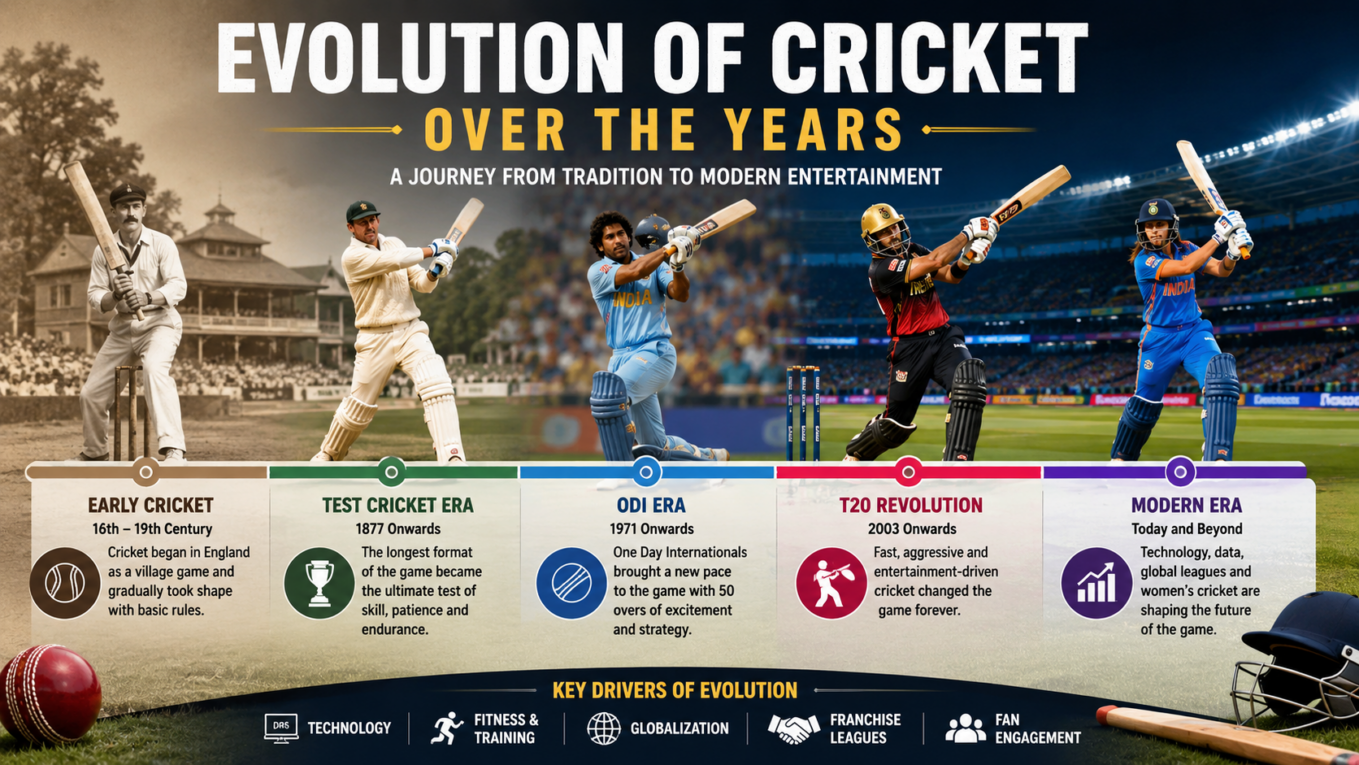
Evolution of Cricket Over the Years
Cricket is one of those rare sports that has managed to evolve with time without losing its traditional charm. From being a slow-paced game played in English villages to becoming a global entertainment industry, cricket’s journey reflects how sport can adapt to culture, technology, and audience expectations. The evolution of cricket over the years shows a clear shift in formats, professionalism, gender inclusion, and global reach.
Origins and Global Expansion of Cricket
Cricket began in England centuries ago and slowly developed into an organized sport with formal rules and structured competitions. As the British Empire expanded, the game spread to countries like India, Australia, South Africa, and the West Indies. These regions later became the backbone of international cricket.
One of the biggest turning points in global cricket history was the introduction of world tournaments, especially the ICC Cricket World Cup. This event transformed cricket from bilateral series into a global competition where nations compete for ultimate glory.
The significance of this tournament is well documented, showing how it shaped modern cricket into a globally followed sport with massive commercial and cultural impact.
Cricket World Cup – History and Evolution
Over time, cricket became more competitive, with each country developing its own playing style. Australia became known for aggressive dominance, India for technical batting depth, and the West Indies for explosive power-hitting during their golden era.
Evolution of Women’s Cricket
Women’s cricket has experienced one of the most inspiring transformations in sports history. In its early years, it received very little recognition and was often played without professional support or media attention. Despite this, women players continued to build the foundation of what is now a rapidly growing global sport.
In England, women’s cricket played a crucial role in shaping organized competitions and establishing international matches. Historical accounts show how early female cricketers fought against limited resources and social barriers to keep the sport alive and competitive.
Women in Whites – History of Women’s Cricket in England
Today, women’s cricket is no longer on the sidelines. Major ICC tournaments, franchise leagues, and increased broadcasting coverage have helped the women’s game achieve global recognition. Leagues such as the Women’s Premier League and The Hundred have created professional opportunities and improved the quality of competition.
This transformation represents a major step toward equality in sports and highlights how cricket continues to grow in inclusivity and representation.
Rise of T20 Cricket and Modern Entertainment Era
The introduction of T20 cricket completely changed the way the game is played and consumed. Earlier, Test cricket dominated the sport with matches lasting up to five days, focusing on patience and technique. Later, One Day Internationals added more pace, but it was T20 cricket that truly revolutionized the format.
T20 cricket brought entertainment, aggression, and unpredictability into the game. It made cricket more accessible to global audiences who prefer shorter, high-energy sporting experiences.
Franchise leagues like the IPL and Big Bash League turned cricket into a year-round entertainment product. Players became global stars, and cricket started influencing pop culture, business, and digital media.
Modern players also speak about how cricket is expanding into new markets and formats. Discussions around cricket’s inclusion in global multi-sport events such as the Olympics highlight how the sport continues to evolve internationally.
Modern Cricket Evolution and T20 Expansion Insights
Technology and Strategy in Modern Cricket
Modern cricket is deeply influenced by technology. Systems like DRS (Decision Review System), Hawk-Eye tracking, and ultra-slow-motion replays have made the game more accurate and fair.
Teams now rely heavily on data analytics to study player performance, pitch behavior, and opposition weaknesses. Fitness and athletic standards have also improved significantly, with players focusing on strength, agility, and endurance.
Digital platforms have further changed fan engagement. Live streaming, social media updates, and highlight reels allow fans to follow cricket in real-time from anywhere in the world.
Globalization and Commercial Growth of Cricket
Cricket today is not just a sport; it is a global business ecosystem. Sponsorships, broadcasting rights, and franchise leagues generate billions in revenue. The IPL alone has become one of the richest sporting leagues in the world, attracting international talent and massive audiences.
This commercial growth has also helped associate nations develop better infrastructure and gain more exposure at the international level. Countries like Afghanistan and Ireland have shown remarkable progress due to increased opportunities.
FAQs
1. How has cricket evolved over the years?
Cricket has evolved from traditional Test matches to include ODI and T20 formats, along with technological advancements, globalization, and professional franchise leagues.
2. Why is the Cricket World Cup important?
The Cricket World Cup is the most prestigious international tournament that brings together top cricketing nations and defines global rankings and legacy.
3. How has women’s cricket changed?
Women’s cricket has grown from underfunded beginnings to a professional global sport with international tournaments, leagues, and media coverage.
4. What impact has T20 cricket had?
T20 cricket has made the game faster, more entertaining, and commercially successful, attracting younger audiences worldwide.
Final Thought
The evolution of cricket reflects a sport that continuously reinvents itself while preserving its core identity. From historic Test matches to the explosive rise of T20 cricket, from the early struggles of women’s cricket to its current global recognition, the game has become more inclusive, dynamic, and commercially powerful. As cricket moves forward, its ability to adapt will ensure it remains one of the most followed sports in the world for generations to come.