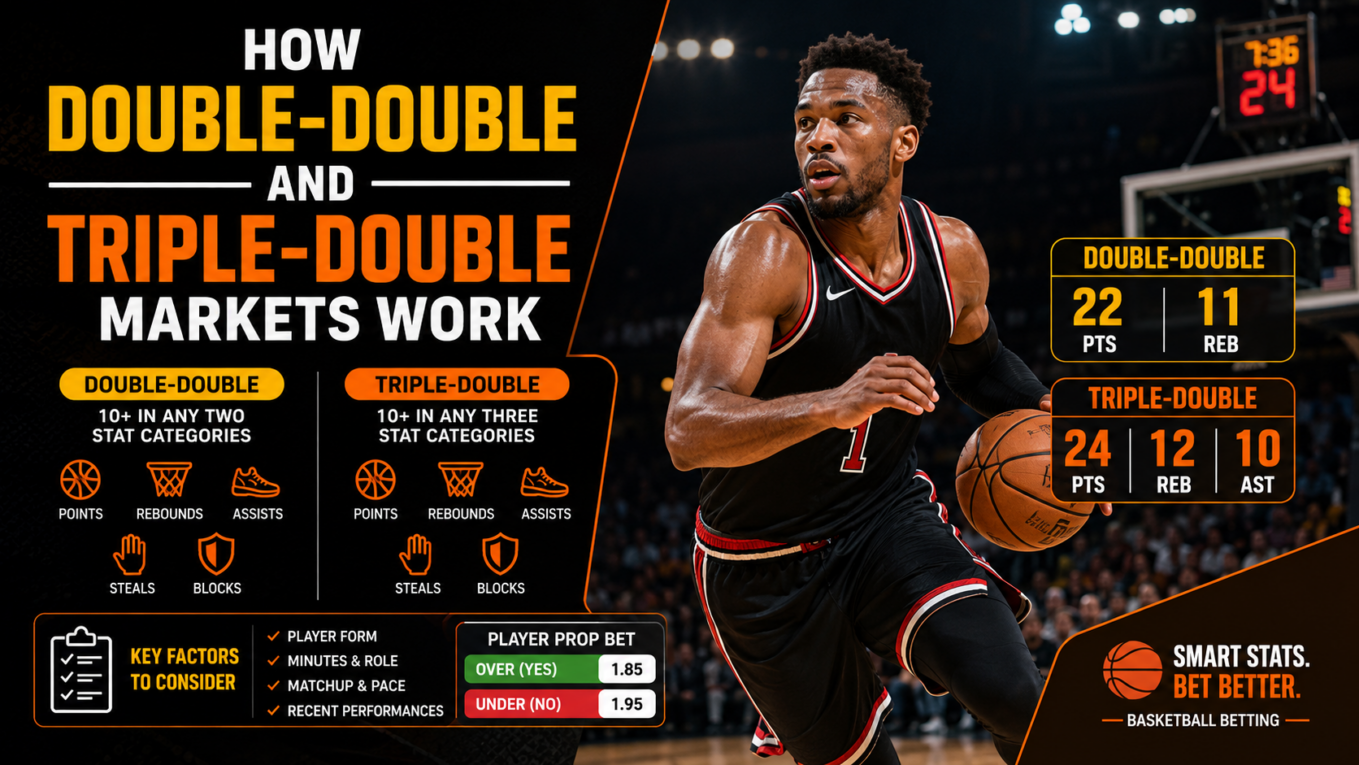
Basketball betting offers far more options than simply picking which team will win. Player performance markets have become an important part of the betting landscape, giving bettors the opportunity to focus on individual statistics rather than the final score. Among these options, double-double and triple-double markets stand out because they are based on a player’s all-around performance.
Understanding how these markets work is important before placing any wager. The outcome depends on official player statistics, and even a strong performance may not be enough if the player falls short in one required category. For anyone interested in basketball betting, knowing the difference between these markets can make player-prop selections easier to understand.
What Is a Double-Double?
A double-double occurs when a player records at least 10 in two statistical categories during a game. The five categories generally considered are points, rebounds, assists, steals, and blocks. The NBA’s official statistical glossary also recognizes double-doubles as reaching double figures in two categories.
The most common combinations are:
- 10+ points and 10+ rebounds
- 10+ points and 10+ assists
- 10+ rebounds and 10+ assists
For example, if a player finishes a game with 22 points and 11 rebounds, that player has recorded a double-double. If the same player scores 18 points and provides 12 assists, that also qualifies.
The important point is that the player does not need to reach 20 in either category. Ten is the threshold, so 10 points and 10 rebounds is enough.
What Is a Triple-Double?
A triple-double requires a player to reach double figures in three of the five main statistical categories. The NBA describes a triple-double as double-digit totals in three categories, while FIBA uses the same basic definition.
The most common combination is:
10+ points + 10+ rebounds + 10+ assists
For example, a stat line of 24 points, 12 rebounds, and 11 assists would produce a triple-double.
Triple-doubles are more difficult because the player must contribute at a high level in three different areas. This makes the market more selective and, in many cases, gives it higher odds than a standard double-double selection.
How Double-Double Betting Markets Work
A double-double market normally asks whether a specific player will record a double-double during the selected game.
A sportsbook may offer selections such as:
- Player A to record a double-double
- Player A not to record a double-double
The odds reflect the estimated probability of the player reaching the required milestone.
Before considering a selection, it is useful to examine the player’s recent performances. A center who regularly collects rebounds and scores efficiently may have a strong profile for a points-and-rebounds double-double. Meanwhile, a primary ball-handler who creates opportunities for teammates may be more dependent on points and assists.
However, past performance does not guarantee the outcome. Minutes, injuries, matchups, foul trouble, game pace, and coaching decisions can all affect the final statistics.
How Triple-Double Betting Markets Work
Triple-double markets follow the same basic principle but require one additional statistical category.
A player must reach at least 10 in three eligible categories for the wager to qualify. This means a player could score 30 points and collect 14 rebounds but still lose a triple-double bet if they finish with only eight assists.
This is why player role is particularly important. Players who handle the ball frequently while also contributing on the glass are often better suited to triple-double markets.
Recent NBA history shows how valuable all-around players can be in these markets. NBA.com currently lists Russell Westbrook as the career leader in regular-season triple-doubles, followed by Nikola Jokić and other elite all-around players.
Key Factors to Check Before Betting
Statistics should be the starting point, but they should not be the only consideration. Several factors can influence whether a player reaches a double-double or triple-double.
Recent Form
Look at the player’s last several games rather than relying only on season averages. A player may have a strong season record but recently be playing fewer minutes or producing fewer assists.
Minutes and Playing Time
More court time creates more opportunities to accumulate statistics. A player expected to play 35 minutes has more chances to reach a milestone than someone projected for 20 minutes.
Opponent Matchup
The opposing team’s defensive style can influence individual statistics. Strong rebounding teams may make it harder for a player to collect boards, while aggressive defenses can affect passing opportunities.
Game Pace
Fast-paced games generally create more possessions. More possessions can mean additional opportunities for points, rebounds, and assists.
Player Role
Usage and responsibility are particularly important. A primary playmaker may have a better path to assists, while a dominant interior player may have a clearer route to rebounds.
Why These Markets Require Careful Analysis
Double-double and triple-double bets can look attractive because the target is easy to understand. However, the final few statistics can be difficult to predict.
A player might enter the fourth quarter with nine rebounds and nine assists but fail to reach either milestone. Another player could reach the required numbers early and make the bet comfortable.
This is why bettors should avoid judging a market solely by a player’s reputation. A star player can have an excellent game without producing a double-double or triple-double.
Official statistics are especially important because these markets are generally settled according to recorded player statistics. Checking reliable sources such as the NBA official stats glossary can help bettors understand the statistical terminology used in these markets.
Double-Double vs Triple-Double: Which Is Easier?
A double-double is generally easier to achieve because the player needs double figures in only two categories. A triple-double requires three categories, making it a more demanding statistical achievement.
For example:
Double-double: 21 points, 12 rebounds, 7 assists
Triple-double: 21 points, 12 rebounds, 10 assists
The first performance qualifies as a double-double but not a triple-double. The second qualifies as both.
The difference of just three assists shows why small statistical changes can have a major impact on these markets.
How Cricbet99 Fits Into Basketball Betting
For bettors interested in player-focused markets, a platform offering basketball markets can provide access to different ways of following games beyond traditional match-winner bets. basketball betting
Cricbet99’s website lists basketball among its supported sports and specifically mentions NBA betting, EuroLeague matches, international basketball tournaments, live basketball odds, and player-based markets.
As with any sports betting activity, users should check the specific market rules, available selections, odds, and settlement conditions before placing a wager.
FAQs
What is a double-double in basketball betting?
A double-double means a player reaches at least 10 in two eligible statistical categories, such as points, rebounds, or assists, during the same game.
What is a triple-double?
A triple-double occurs when a player records at least 10 in three eligible statistical categories in one game.
Which statistics count for double-doubles and triple-doubles?
The five commonly used categories are points, rebounds, assists, steals, and blocks. Official market rules should always be checked because settlement terms can vary by sportsbook.
Are triple-doubles harder to predict?
Yes. A player needs double figures in three categories instead of two, so there are more statistical requirements to meet.
Can a player record both a double-double and triple-double?
Yes. Every triple-double also satisfies the requirements for a double-double because the player has reached double figures in at least two categories.
Final Thought
Double-double and triple-double markets add another layer to basketball betting by focusing on individual player performances. The basic rules are straightforward, but making informed selections requires attention to recent form, minutes, player role, matchup, pace, and statistical trends.
Rather than relying only on a player’s name or reputation, bettors should study how that player produces statistics and whether the upcoming matchup supports those opportunities. Understanding the market first and checking the relevant rules can make these player-prop markets much easier to evaluate.