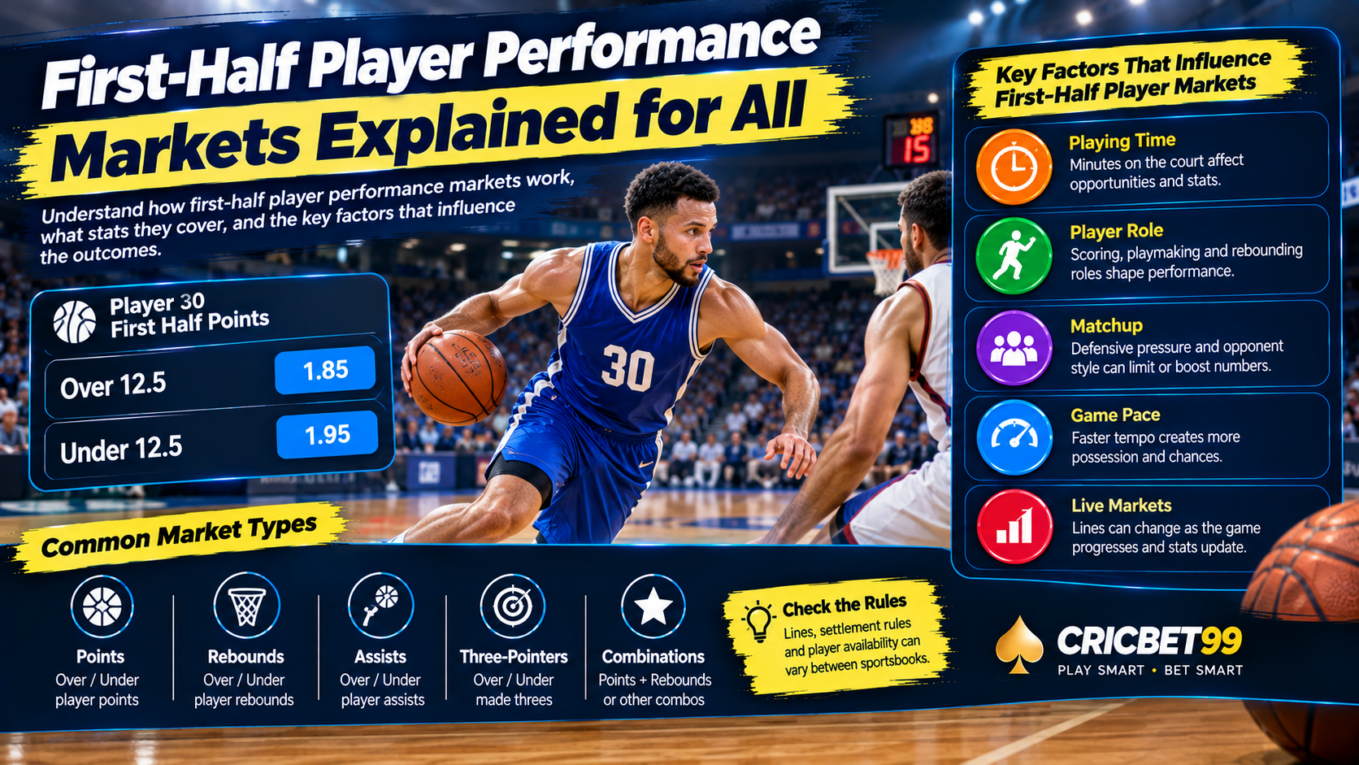
Basketball betting includes many markets that focus on individual player statistics rather than the final game result. One of these is the first-half player performance market, which looks at what a selected player achieves during the opening half of a basketball game.
Instead of covering the full game, these markets have a defined time period. Depending on the sportsbook, they may focus on points, rebounds, assists, three-pointers, or combinations of statistics. For readers comparing different Cricbet99 basketball betting markets, understanding the time limit and settlement conditions is essential before interpreting a first-half player market.
What Are First-Half Player Performance Markets?
A first-half player performance market is based on a player’s statistical performance during the first half only.
For example, a market could show:
- Player A — Over 12.5 points
- Player A — Under 12.5 points
If the player scores 13 or more points during the first half, the over selection qualifies. If the player scores 12 or fewer, the under selection qualifies, subject to the sportsbook’s stated rules.
The same concept can apply to rebounds, assists, three-pointers, steals, or other player statistics.
The NBA’s official statistics system separately tracks player statistics and allows data to be filtered by half, showing that first-half performance can be measured independently from full-game production.
How Does a First-Half Market Differ From a Full-Game Market?
The biggest difference is the time period.
A full-game player points market considers the player’s statistics across the entire game. A first-half market only considers what happens before halftime.
Imagine a player finishes a game with:
- 24 points
- 8 rebounds
- 6 assists
Those numbers do not tell you how the performance was distributed.
The player might have scored 16 points in the first half and only eight after halftime. Another player could score four points before halftime and 20 in the second half.
For a first-half market, only the statistics recorded during the opening half matter.
Common First-Half Player Markets
The exact markets available depend on the sportsbook and competition, but several statistical categories are common.
First-Half Points
This market focuses on the number of points scored by an individual player before halftime.
A line might be set at 10.5 points. The player would need to score at least 11 points during the first half for an over selection to qualify.
First-Half Rebounds
Rebounds are another common statistical category. The NBA defines a rebound as a player recovering the ball after a missed shot, with total rebounds including offensive and defensive rebounds.
A first-half rebound market therefore counts the player’s qualifying rebounds before halftime.
First-Half Assists
Assists measure passes that lead directly to made baskets. A first-half assists market only counts those assists recorded during the opening half.
First-Half Three-Pointers
Some markets focus specifically on successful three-point field goals made during the first half. These are different from total three-point attempts because the market generally concerns made shots.
Combined Player Markets
Some sportsbooks may also offer combinations such as points and rebounds or points, rebounds, and assists. The exact format and settlement rules depend on the platform.
How Over and Under Lines Work
Most player performance markets use a numerical line.
Consider this example:
First-Half Player Points — 11.5
There are two basic options:
Over 11.5: The player must score at least 12 points before halftime.
Under 11.5: The player must score 11 or fewer points before halftime.
Half-number lines make the settlement straightforward because the player’s final statistic cannot equal 11.5.
However, users should always check the individual market’s rules, especially for situations involving limited playing time, injuries, or players who do not enter the game.
Why Playing Time Matters
Minutes are particularly important in first-half player performance markets.
A player can have an efficient start but still finish below a market line if they spend significant time on the bench. Rotation patterns, early foul trouble, coaching decisions, and game circumstances can all influence playing time.
For example, a starting player might normally play a significant portion of the first half, but two early fouls could reduce their minutes.
That is one reason first-half markets can behave differently from full-game markets.
Player Role and Usage
A player’s role within the offense can also influence first-half statistics.
Some players are primary scorers and receive a large share of their team’s offensive opportunities. Others are more focused on passing, rebounding, defense, or creating opportunities for teammates.
NBA statistics include measures such as points, rebounds, assists, usage, field-goal attempts, three-point attempts, and free throws, giving different ways to describe how players contribute during a game.
Understanding a player’s role can therefore provide useful context when reading a performance market.
Matchup and Defensive Pressure
The opposing team’s defensive approach can affect an individual player’s opportunities.
A strong perimeter defender may make scoring more difficult for a guard. A team with strong interior defense may reduce easy scoring opportunities near the basket. Defensive attention can also create passing opportunities for another player.
This means an individual performance should be viewed within the context of the matchup rather than as an isolated statistic.
Game Pace Can Influence First-Half Statistics
The pace of a basketball game can affect how many possessions each team receives.
More possessions can create additional opportunities for shots, rebounds, assists, and other statistical events. A slower game may provide fewer opportunities during the same period.
However, pace alone does not determine a player’s performance. Shooting efficiency, rotations, defensive strategy, turnovers, and foul situations can all change the number of opportunities available.
Live First-Half Player Markets
First-half player markets can sometimes be available while the game is in progress.
For example, a player might have six points after the first quarter. A live market could then offer a new first-half points line based on the remaining time before halftime.
As the clock runs down, the available market can change quickly. A player who already has several points may have less time remaining to reach a new line.
Live markets can also be temporarily suspended following important events, such as injuries, free throws, timeouts, or other significant game situations.
What Happens if a Player Does Not Play?
Player performance markets can have specific rules covering non-participation.
Some sportsbooks may void a market if the selected player does not take part in the game. Other rules may apply when a player enters the game but records limited minutes.
Because these conditions can vary, it is important to check the sportsbook’s settlement terms before placing a wager.
Common Mistakes to Avoid
One common mistake is confusing first-half statistics with full-game statistics. A player’s final box-score numbers do not determine a first-half market.
Another mistake is ignoring playing time. Even a high-volume player can fall short of a first-half line if their minutes are reduced.
It is also easy to focus only on scoring. Rebounds and assists depend on different factors, so the player’s role and the team’s style should be considered separately.
Finally, users should avoid assuming that a strong recent performance automatically guarantees another strong first half. Every game has different circumstances.
Frequently Asked Questions
What is a first-half player performance market?
It is a basketball betting market based on an individual player’s statistics during the first half of a game.
What statistics can be included?
Depending on the sportsbook, markets may cover points, rebounds, assists, three-pointers, steals, or combinations of player statistics.
Does the second half count?
No. A standard first-half market is settled using qualifying statistics recorded before halftime.
What does over 10.5 first-half points mean?
It generally means the player must score at least 11 points during the first half.
Can first-half player markets be available live?
Yes. Some sportsbooks may offer live first-half markets while the opening half is underway, subject to market availability.
Does playing time affect first-half player markets?
Yes. Minutes can directly affect the number of opportunities a player has to accumulate points, rebounds, assists, and other statistics.
Where can basketball player statistics be checked?
The NBA’s official statistics platform provides player data and includes filters for different game segments, including first-half statistics.
Final Thought
First-half player performance markets provide a focused way to follow individual basketball statistics during the opening half of a game. Unlike full-game markets, they have a fixed time window, making playing time, pace, player role, matchup, and early-game opportunities especially relevant.
Understanding exactly what statistic is being measured is the first step. From there, checking the market line, settlement rules, player availability, and official statistics can make the market easier to interpret.
First-half performance can change quickly because basketball is a fast-moving sport. No statistical trend guarantees a particular result, so these markets should be approached with clear expectations, an understanding of the rules, and sensible betting limits.