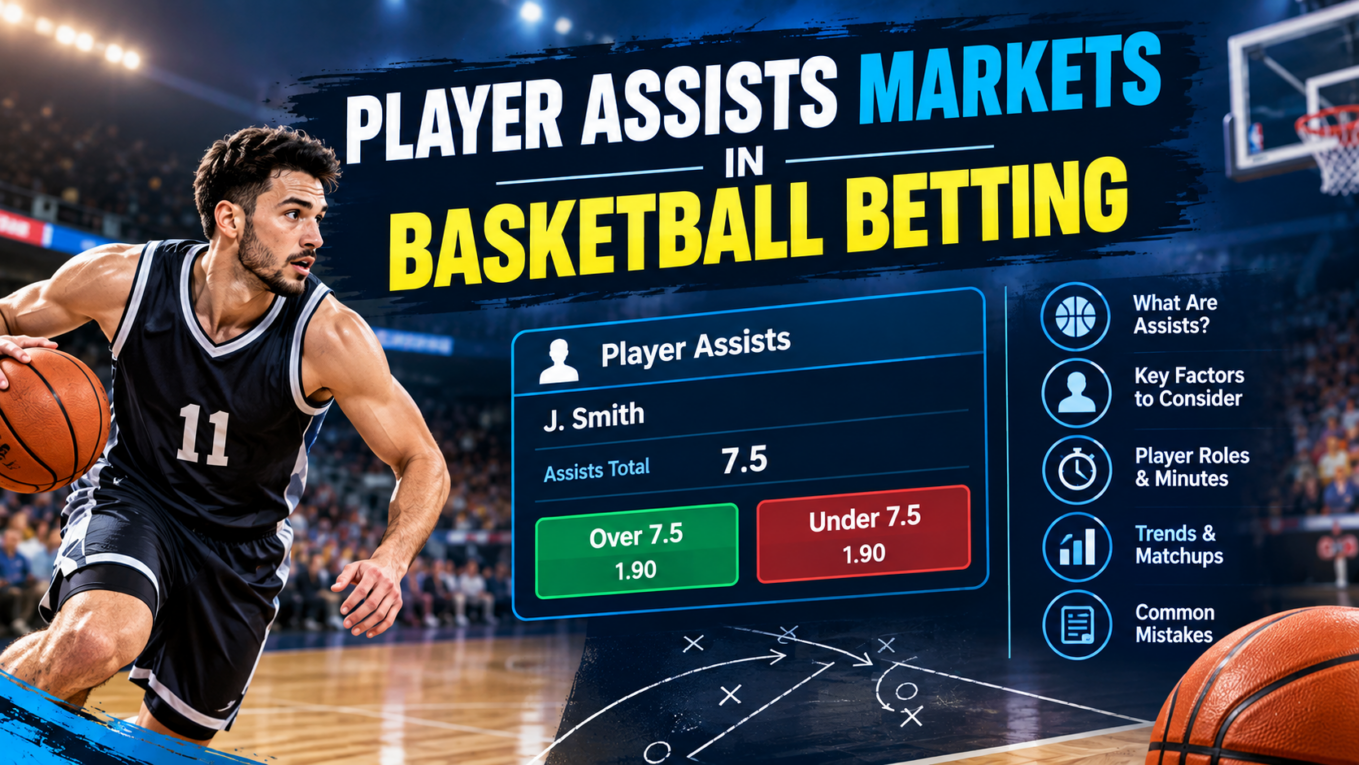
Basketball betting covers far more than simply predicting which team will win. Alongside moneyline, point spread, and total-points markets, bettors can also find player props based on individual statistics. One of the more interesting options is the player assists market.
An assists market focuses on a player’s ability to create scoring opportunities for teammates. It can be especially relevant when a team’s offense runs through a primary ball-handler or playmaker. However, understanding how assists are recorded and how the betting line is settled is important before considering this type of market.
What Is an Assist in Basketball?
An assist is generally credited when a player’s pass directly leads to a teammate scoring a basket. The NBA’s official statistics glossary defines assists as passes that lead directly to a made basket. [NBA Stats Glossary]
FIBA’s statistical manual also defines an assist as a pass that leads directly to a teammate scoring, while providing detailed guidelines for situations involving dribbles, defensive pressure, and other game situations. [FIBA Statisticians’ Manual]
The statistic therefore measures more than simply passing the ball. The pass must contribute directly to the scoring play according to the statistical rules being used.
What Is a Player Assists Betting Market?
A player assists market allows a bettor to select whether a particular player will finish above or below a listed assists line.
For example, imagine a player has an assists line of 7.5.
The two common selections are:
- Over 7.5 assists: The player must record at least 8 assists.
- Under 7.5 assists: The player must record 7 or fewer assists.
The final result is based on the officially recorded assists for that player. If a player finishes with exactly 7 assists, an Over 7.5 selection would not be successful.
Half-number lines are commonly used because they remove the possibility of an exact tie.
Why Player Role Matters
A player’s role within the offense is one of the first things worth considering when looking at an assists market.
Point guards and primary ball-handlers often have more opportunities to create plays because they spend significant time controlling the ball. However, position alone does not determine assist opportunities.
A wing player can also produce a high number of assists if their team uses them as a secondary playmaker. Similarly, a big man involved heavily in handoffs and passing from the high post can contribute more assists than his position might initially suggest.
The key is understanding how the player is actually used.
Minutes Are an Important Factor
Playing time can have a major effect on player props.
A player who normally plays 34 to 38 minutes has more opportunities to record assists than someone who regularly plays around 20 minutes. This does not guarantee a higher assist total, but minutes create more possessions in which a player can make scoring passes.
Before considering an assists line, it is useful to check whether the player’s expected workload is stable.
Injuries, foul trouble, rotations, back-to-back games, and coaching decisions can all affect playing time.
Usage and Ball-Handling Responsibilities
A player’s usage is another important piece of the picture.
High-usage scorers sometimes have fewer assist opportunities if they spend more possessions creating their own shots. On the other hand, a player who regularly initiates the offense may have more opportunities to create baskets for teammates.
This is why looking at assists alone may not provide enough context.
A better approach is to consider the player’s role, touches, ball-handling responsibilities, and relationship with the team’s main scoring options.
Teammate Shooting Can Affect Assist Numbers
An assist requires a teammate to score.
This means a player’s passing ability is only part of the equation. Teammates also need to convert the opportunities created by those passes.
A player may make several high-quality passes in a game but finish with a modest assist total if teammates miss open shots. Conversely, accurate shooting from teammates can turn ordinary playmaking opportunities into additional assists.
This makes assists different from some statistics that depend primarily on the player’s own actions.
Pace and Matchup Can Matter
Game pace can influence the number of possessions available during a match. More possessions can create additional opportunities for passes and scoring plays.
The opponent’s defensive approach also matters. Some teams allow more ball movement and open perimeter opportunities, while others focus on limiting certain playmaking options.
Rather than relying on a single pace or defensive statistic, it can be useful to consider the matchup as a whole.
Recent Form Should Be Put Into Context
Recent assist numbers can provide useful information, but they should not be treated as a guarantee.
Suppose a player recorded 9, 8, 6, 10, and 7 assists over five games. The numbers show a range of outcomes rather than a fixed expectation.
It is worth asking why those results occurred.
Was the player receiving more minutes? Did a teammate miss games? Was the team playing at a different pace? Did the player’s role change?
Context can often explain a statistical change better than the raw average alone.
Official Statistics and Market Settlement
One important detail in player-prop markets is the statistical source used for settlement.
Official scorers determine whether a pass qualifies as an assist according to the competition’s statistical rules. Close plays can sometimes involve judgment, which makes the official box score particularly important.
The NBA maintains an official statistical glossary covering assists and related metrics, while FIBA publishes detailed statistical guidelines for recording assists and other box-score events.
Checking the applicable market rules before placing a bet can help avoid confusion about how a particular result is settled.
Common Mistakes in Player Assists Markets
One common mistake is focusing only on a player’s season average.
A season average may not reflect the player’s current role, expected minutes, teammates, or matchup.
Another mistake is ignoring lineup changes. If a team’s primary playmaker is unavailable, another player may suddenly take on greater ball-handling responsibilities.
It is also easy to overlook shooting efficiency. A player can create plenty of opportunities without producing a large assist total if teammates are struggling to finish.
Finally, bettors should avoid treating one strong or weak performance as a reliable prediction of the next game.
FAQs About Player Assists Markets
What does Over 6.5 assists mean?
Over 6.5 assists means the selected player needs to record at least 7 official assists for the selection to be successful.
What does Under 6.5 assists mean?
Under 6.5 means the player must finish the game with 6 or fewer official assists.
Does every good pass count as an assist?
No. An assist is generally awarded when a pass directly contributes to a teammate’s made basket according to the competition’s statistical rules.
Can a player’s minutes affect an assists market?
Yes. More playing time generally provides more opportunities to handle the ball and create scoring chances, although it does not guarantee a specific number of assists.
Do missed shots count as assists?
Normally, a missed shot does not produce an assist because an assist is tied to a made basket under the standard definition.
Why should official statistics be checked?
Official statistics determine the recorded assist total used for the final result. Statistical rules can also differ between competitions, so checking the relevant rules and box score is important.
Final Thought
Player assists markets add a strategic statistical angle to basketball betting. Instead of focusing only on the final score, these markets require attention to player roles, minutes, ball-handling responsibilities, teammate shooting, pace, and the specific matchup.
The most useful approach is to look beyond a player’s headline assist average and understand the circumstances behind the number. Official statistics and market settlement rules should also be checked before relying on any figure.
For readers interested in broader sports markets and basketball betting, comparing available information, understanding the terminology, and maintaining responsible betting habits can make these markets easier to follow. Always check the rules and legal requirements that apply in your location, and never treat betting outcomes as guaranteed.